I took a long, good look through the General's Handbook, and here's what I think.

First of all, the price can't be beat. $25 for a 169 page book is great, and it's chock full of good stuff. Army points aside, there are a few scenarios and campaign ideas that have me really excited to get some models on the table again.
One thing I keep hearing about Age of Sigmar is that the four-page rules pack doesn't really make for interesting games, or even balanced games, and that scenarios are essential to maintaining some kind of direction. Otherwise it's just putting out whatever you want and pushing it all into a pile in the middle. Unfortunately, the only way to get those crucial game-making scenarios was to pick up the different battletomes at the tune of $60 a pop. That's a lot of money to make the game boasting free rules "playable."
For $25 the General's Handbook gives you 26 battleplans (scenarios) across the various campaign formats and pitched battle guidelines. Here's a quick overview and some opinions on the different chapters:
Multiplayer Rules
This section outlines two different types of multiplayer battles– Coalition of Death (team play) and Triumph & Treachery (every man for himself). There are two Coalition scenarios and four Triumph & Treachery scenarios.
I really like the "Might is Right" scenario where the board is organized in more of a "hexagon" shape, allowing up to six players to deploy in a circle around the center of the map. The game is won by the payer that controls the most board sections at the end of a randomly-determined game length, encouraging players to get out of their deployment zones and mix it up.

Narrative Play
There are four narrative battle plans, based around telling a story. These assign a unique command ability to each side, or features an in-game event or action to spice things up. There are also two scenarios based on recreating battles of the past, one of which is an epic clash between Archaon and Nagash, incorporating multiple players and armies.

Path to Glory
This is a campaign where the participants generate small warbands and track progression through unit upgrades and awards for the champion leading the warband. It looks like a neat way to break into some structured Age of Sigmar games with a new army or small collection. It's relatively open, with charts for selecting the warband's followers. The rules say you can pick the followers you want, but the charts are set up so you can randomize things with a dice roll if you prefer.
Participants play games and score points after each game, D3 points for a win, and 1 point for a loss or draw. The first to 10 points wins the campaign if they can win another, final battle. There are only two scenarios in this section, but I'm sure most of the others could be used with a little modification.
My critique of this would be that it seems like a couple players could dominate by spamming games and reaching the target number of points. And the campaign leaders could be prevented from achieving victory by the other players simply refusing to play anyone who has 10 points. It's all really dependent on your gaming group; a min-maxing win-at-all-costs group might run into the problems I just outlined, but a more relaxed group would probably have fun. Something as simple as setting a date, before which no player can fight their final battle, would allow everyone ample time to rack up their points. And maybe the final battle could only be fought against another player with 10 points, so they each have an equal stake in the result and might be more evenly matched.
Something weird I noticed in the warband rosters is that the Skaven charts allow the player to pick freely from all the Skaven clans, but the Death charts restrict the player to only one "Death allegience." for example, if you pick Deathrattle as your allegience, you only get a Wight King as your champion, and the only followers you have access to are Skeletons, Grave Guard, and Black Knights. That's a pretty narrow selection, and all of the ethereal stuff is completely absent from any of the allegiences. Furthermore, the Flesh-eater Court chart is the only one that allows heroes and monsters as followers, and it doesn't have Vargheists or Crypt Flayers, only Crypt Horrors.
That seems like something most players would want to house rule to allow more diverse Undead armies. (I, personally, would like to play with more than only three of the 20+ units available to the Undead!) Actually, MOST of the armies are left out of the Path to Glory and it seems limited to only the factions that have been included in the Age of Sigmar (Chaos, Stormcast, Fyreslayers, Skaven, Ironjaws, Sylvaneth, and Death), so a little creativity will be required to make it inclusive to participants who want to play with Seraphon, Bretonnians, or the Empire.
Map Campaigns

I dig the new "map" campaign, although it's more of a "location" campaign since it doesn't rely on players conquering territory on a map, maintain borders, and attacking their neighbors. While I do enjoy the style of map campaign I ran with my friends, it requires a certain level of dedication, and that dedication really gets tested as the campaign goes on and players occupying larger swathes of land on the map are required to fight more and more battles each campaign turn. (It's my experience that the players' motivation always decreases over time, not the other way around.)
With this new style of map campaign, players are not locked into only fighting players they are adjacent to, and there are no "scheduled" battles that need to occur for the campaign to continue. Participants can play if they are available and don't need to be bothered if they don't have the time, or have to drop out. The campaign round is structured in terms of months, with players playing whenever or whomever they want each month. They decide on a map location to fight over, and at the end of the month, whichever player has the most victories at a given location gets victory points and an in-game bonus awarded for the following month. At the end of a set number of months whoever accumulated the most victory points wins the campaign. Simple.
I'm itching to model a three-dimensional map, complete with miniature counters to represent the players' armies that have captured the locations each round, and some "trophy markers" that the players would place on the battlefield to represent the bonuses they've earned for that month. For example, a sword or helmet bearer to go next to a hero that is using an attack or armor bonus.
Tree and Matrix Campaigns
The tree campaign is a series of linked battles, one leading to another based on the result of the previous game. There are six scenarios, but following the paths on the tree, you'll likely only play three or four of them. Tree campaigns look short, but are a nice way to play a series of linked games with a narrative, rather than just setting up for one pitched battle game after another.

The matrix campaign looks more like a series of battle modifiers than a straight-up campaign. Essentially, when preparing for a battle, each player picks a strategy in secret. Strategies are things like swinging around the flank by fording a river, holding position to await reinforcements, scouting the enemy's position, or engaging straight away. The players then cross reference their strategies on the chart to see what modifiers will be added to the game. One player might get to deploy ambushers, or get additional troops. Units might be injured before the battle starts while moving into a flanking position over dangerous ground. Neat stuff to shake up the same-old-same-old.

Matched Play
The matched play section has rules for a ladder campaign (challenging people above you on a ladder, king-of-the-hill style.) It also has rules for playing pitched battles using a point structure for players to build their armies to an equal value. The pitched battles themselves are six scenarios focused around capturing battlefield objectives.
The Pitched Battle rules also assign battlefield roles to the different units, such as Leader, Battleline, Artillery, and Behemoth. Armies require a minimum number of Battleline units (core troops) and set a maximum for the others based on the size of the army.
There are also grand alliance abilities– If all the units in an army have the same alliance key word the player gets a battle trait for the army, and can choose a command trait for his general and a magic artifact for one of his heroes. That's a nice way to add a little uniqueness to each army. I'm very happy to see that the Cursed Book is among the Artefacts of Death, and just like it did many years ago, the book gives living models near it -1 on their hit rolls. My necromancer Nieman Kimmel will be pleased!
The points are arranged by Age of Sigmar Grand Alliance faction, and then in a "legacy" section which has all of the remaining entries from the initial warscroll compendium roll out. Skaven, for example are all listed under the Chaos section. Since Skavenslaves are absent from "Age of Sigmar proper" their points are found in the compendium section along with all of the dropped special characters. So you can build a complete army, it just might be scattered across a couple sections. Same for the other Old World armies. That's a minor quibble, though.
Tomb Kings are in there, as are the Bretonnians. The Varghulf only has the one point value under the Flesh Eater Courts, and no alternate cost for the Vampire Counts compendium scroll or Grand Alliance Death scroll. I would assume the two just share the same point cost even though the two scrolls have different rules? Or maybe the Varghulf Courtier is the only Varghulf available now? I guess it's whatever the group agrees on. Not really a big issue though.
The available warscroll battalions are also referenced in the points section, but you'll need the relevant battletome or grand alliance book to get the details of the battalion itself. The battalion points listed are said to be an extra cost to get its bonuses and the units in it need to be paid for separately.
There are those who say that points are never balanced, but that's fine. Even in the tightest rule sets, people still complain about a particular unit being too costly for what it does, or vice versa. Points are really just a guide anyway, an easy watermark for building a specific size army to play games without having to go through as much trial-and-error to find out what will make a balanced fight. Gaming groups or tournament organizers can adjust the points as necessary.
I saw online that some people are already complaining about the Battleline designations as being too restrictive. I guess they missed the part where the book tells you that you can just use the points and ignore the classifications, or that the entire book is optional, and that players are free to pick and choose the parts that work for their gaming community. I guess there's no wining– People want the structure of army points and list building and then complain when they get it.
I personally haven't had a chance to sit down and crunch numbers on a list, so I really don't have an opinion on the point values themselves. I'm also not the kind of player who reads and evaluates unit warscrolls that aren't part of my own army, or who "theory-hammers" out every conceivable combination, so I can't say whether a particular Chaos or Orc unit might be over or under-costed.
Photography
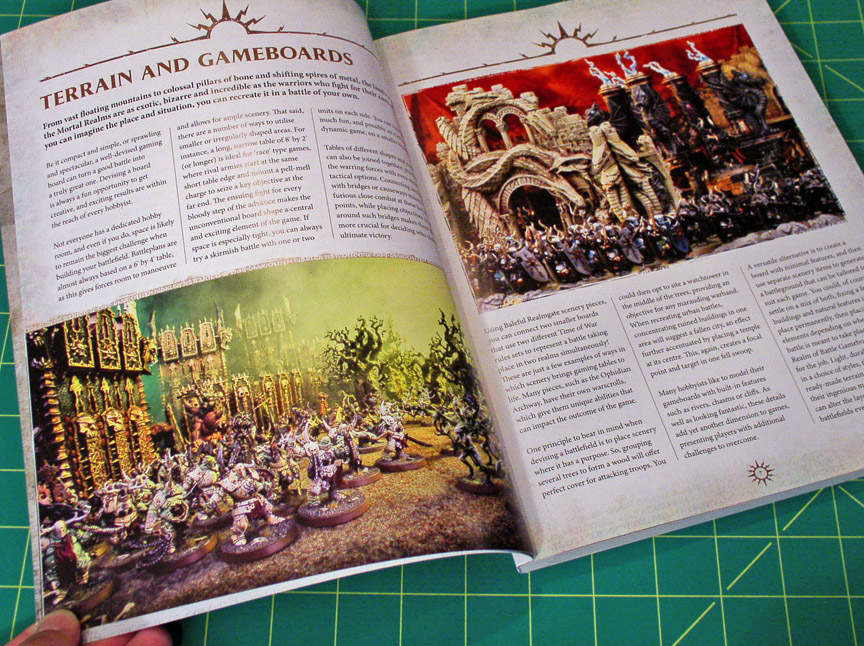
My only gripe with the book (and it's a big one) is its photography. If you're thinking of picking up this book for some serious "miniature porn" don't get your hopes up. While the photos of the models are fine, there is too much focus on the models and zero attention given to the setting. I find that very disappointing as a terrain enthusiast.

Especially, for a game that is is designed to incorporate terrain more, and has special rules for every piece of scenery on the board, there is a serious lack of terrain in any of the photos. The environment is kind of important to forging a narrative game, and the book does nothing to establish the environment visually.
This two-page spread is the only section in the book that really addresses battlefield scenery, and the scenery isn't even showcased that well:

I'm starting to think that the 8th Edition Warhammer rulebook might be the last Games Workshop publication to get me excited about looking at tabletop wargaming imagery. Every one of these images tells a story, as much with its models as with its setting.

Even these simple Elven columns establish that this forest is on the border of the Elven territory, or near a ruined fort:

The photo accompanying this "battle for the pass" scenario, even though it's just a bunch of rocks with a Dwarven stronghold barely visible in the background, does more to establish where this fight is happening than any of the pictures in the General's Handbook.

I know GW is in the business of selling models and not scratch-built scenery, but the lush scenery is what gets people excited to want to put models on it.

I mean, look at this! Talk about forging a narrative!


Compare that epic clash between Dark Elves streaming off their ships to invade the High Elf kingdom, to this image of the forces from the Fate of Shyish battle:

The armies look nice, but they're partially obscured by smoke, and the setting isn't established at all. Is the Realm of Death is supposed to be devoid and barren? Because the setup for the battlefield describes it as being studded with the ruins of ancient tombs.

The battle of the century between Archaon and Nagash, and it's happening... literally nowhere.
I understand that GW wants to promote their own line of plastic terrain kits, and that's fine, but at least show them in the background. Show some awesome conversions of what the design team has done with the terrain. Look at this spread from the 8th Edition book. The castle is both beautiful and kitbashed from multiple GW scenery kits. And more importantly, it sets the stage and establishes where the battle is occurring and what is at stake. Imagine all the frightened peasants huddled behind those walls. The only thing protecting them is few hundred Empire state troops and knights. That Chaos army is going to wreck that place!

In the General's Handbook, the closest we come to a uniquely converted and inspiring fortification is this Chaos Dreadhold with what looks like a quadruple-sized Realmgate modeled into it. Very cool. I wish we could see it better, or the models around it, for that matter.

There's a neat-looking mountain of skulls in the background of the table featured in the battle report.

And this is as close as we get to it:

The Ophidian Archway on that board also looks like it's converted with overgrown, glowing trees, but it's barely visible. Even the map for the campaign is a piece of custom-built scenery, modeled and painted on a realm of battle board. I would love to see that thing, but we only get this tiny, top-down shot of it.
I guess the days of beautifully modeled, inspiring boards at GW events and in their publications are over.


Now it's just Age of Sigmar ruins, manor houses, and plastic trees on realm of battle boards, all with the exact same built-in hills and skull-filled crevices.
That's the same reason I haven't been interested in looking through 40K books in ages– Because the photos are all the same: Models on Realm of Battle boards in front of Cities of Death ruins and Imperial fortifications. And that's regardless of the army– Orks? Cities of Death terrain. Eldar? They're hanging out in the Imperial Cities of Death ruins. It's boring and repetitive, and it always ends up creating a busy image that doesn't contrast with the models enough. And more specifically, I know I'm not going to see anything new.
But, all my ranting aside, the General's Handbook really is worth picking up. The new rules look like a lot of fun, and I hope sparks some interest to get people back into the hobby in my area.
'Til next time!
The sea monsters are finished! I have yet to play a proper game, but at least I now have enough components painted to accommodate whatever treacherous adversaries the Fate cards reveal.

The Leech Wyrm: Like most of the components in this game, I didn't really find the design interesting until I began painting him. The bone and rotting flesh is a nice, monochromatic palette, and the brownish-purple leeches add a few accents to the model. Now that I think about it, I find the idea of man-sized leeches utterly terrifying.


The Bone Hydra: This guy was a breeze to paint, actually. Drybrushing, washing, and highlighting the bone is second nature to me. Then it was just a matter of picking out the water drips and base. The seaweed was given a simple green basecoat with a very basic overbrushed highlight. Then the water and weeds were all washed with GW Coelia Greenshade. The most time consuming portion was the sail.


The Sea Giant: This is the monster I was most looking forward to painting, with the slimy muck hanging off of him. The detail on his sides is pretty flat, so it needed a lot of fine highlight lines to create the impression of hair. Something I had noticed when I first bought the game is that the sea giant is appropriately proportioned for a conversion with Warhammer models. If I was still building my Zombie Pirate army, I'd be tempted to track down a few more of these giants to use as waterlogged zombies.

If you've been to Gen Con or on the internet, you've probably seen Fantasy Flight's announcement of their new Runewars miniatures game. And if you were at Gen Con you may have seen the demo tables and castle display I built for them. You can check out the Runewars minatures game here, and now that the secret is revealed, I'll be able to show off some photos and work-in-progress pictures of the terrain.
'Til next time!
Skull Forge Scenics: Ruined Graveyard Walls
I've added a new set to the Skull Forge Scenics online store:

These are ruined walls, designed in the same style as my other graveyard walls. The set includes three crumbling wall sections and two wall posts.

The posts work as corners or ends that the walls insert into.


I hope to have my own set painted soon, and I'll definitely post some pictures.

Dreadfleet Final Assembly
The end is finally in sight for this project. Painting is underway on the three sea monsters...

And with only four ships remaining, I decided to assemble the hulls and get them primed and ready to go. The Heldenhammer and Flaming Scimitar went together very easily. I was concerned about getting at the detail on the Heldenhammer, but it's really accessible as a single part. For the Scimitar, I left the tower with the djinn and efreet separate. It will be primed white for the brighter colors.

The Shadewraith was kept in a few parts so I can paint the insides and outsides of the hull halves, since the interior will be visible through the ship's skeletal framework. These are getting primed grey with a white zenith spray.

And then we come to the Bloody Reaver. I'm saving the most complicated ship for last, and I don't know how this is going to work. The join between the ship halves will need to be puttied...

...but there's a sail that needs to be inserted in between the two halves before they are glued together, meaning that the parts should be painted separately.

The outer layer of the hull has detail in the inside that will be difficult to reach once assembled.

But the outer half also includes a portion of the castle that will need to be puttied, so it's another situation of pieces that need to be painted separately. I might be able to separate the castle portion and attach it to the center, but I still don't know what to do with that front sail.

And to top it off, the masts all have ball-and-socket attachment points that need to be inserted before the halves are glued together and no locking key to make sure they're oriented in the right direction.

It may be an assembly nightmare, but this ship is huge– almost five inches long– and I can't wait to see it painted.

'Til next time!
My attention over the past few weeks has been on a large terrain commission, so I haven't been able to blog as frequently. I'll be able to post pictures of it in the coming months, but now that it is out of the way, I can get back to painting and sculpting. Yesterday I knocked out the measuring tools for my Dreadfleet set.

The ship's wheels, used for making 45 degree turns:

The wind gauge, which moves around the perimeter of the seascape to indicate wind direction:

The flip side of the wind gauge is the vortex marker, use to mark the center of the maelstrom in one scenario. I was concerned about having a part lay "painted side down" on the board, but the seascape mat is a soft material, so it probably won't be too rough on the counter.

Finally, there's the navigation rod, which functions as a measuring ruler, and can be bent up to 45 degrees to check facings when firing broadsides.


Next I have the three sea monsters to paint. The Bone Hydra and Sea Giant needed their bases extended a little because they were so top-heavy. (Once the head with the sail was attached, the hydra would tip over at the slightest touch.) I glued the models on some plastic card and sculpted matching waves with some brown stuff modeling putty.

Once they are painted I'll be able to play a game with fully painted components, ready for whatever game effects the fate cards deal– well, except for the little auxiliary ships, but I have something special planned for them.
'Til next time!
I'm right in the middle of a large terrain commission, so I haven't been able to keep up with the blog or the Dreadfleet project. (I expect to have some pictures of the finished table in the coming months). I have been slowly picking away at my Dreadfleet queue, some water here, a sail there... The Leviathan Island (or as I like to call it, the remains of Morla) is finished at last.


The giant turtle island is the last bit of the Galleon's Graveyard terrain for the game. I also finally crested the halfway mark on the ships, by completing the Seadrake. Only four to go!
I've got a couple of progress shots– The ship's hull was sprayed with a bone color, and the dragons were painted first. The highlights on were achieved by mixing a little flesh tone into the red.

Then I finished off the hull details and masts. This was the most painstaking one yet, because I had to carefully paint all the gold trim and details without messing up the white hull. The masts were glued in place before attaching the sails, which were painted separately on the sprue. I kind of like this image because it almost looks like the ship could be at port with its sails down.


Here's the finished Seadrake in all its glory, including a shot of it's back side, which you never see in the books. This is the only whip with a dedicated photogenic side; I had the row of finished ships facing to the left on my shelf but I had to turn them so the Seadrake's "good side" would be visible.


Now that I've got three ships for each side, I'll have to get in a proper game and see how it plays.
'Til next time!